
In today’s competitive online marketplace, businesses invest a significant amount of money in digital marketing. From social media advertising and search engine optimization to email marketing and paid campaigns, there are many ways to reach potential customers online. However, simply spending money on marketing does not guarantee business growth.
Businesses need to understand whether their marketing investment is actually producing results. This is where ROI in digital marketing becomes important.
ROI, or Return on Investment, is a measurement used to understand how much value a business generates from the money it invests in marketing. By measuring digital marketing ROI, businesses can identify successful campaigns, control unnecessary spending, improve marketing strategies, and make better decisions.
In simple terms, ROI in digital marketing helps answer an important question:
“Are we getting enough return from the money we are spending on digital marketing?”
What Is ROI in Digital Marketing?
ROI in digital marketing refers to the return a business receives from its investment in digital marketing activities. It helps businesses understand how effectively their marketing investment is generating revenue or profit. By measuring ROI in digital marketing, marketers can identify which campaigns are performing well and which strategies need improvement.
Digital marketing investments can include:
-
Google Ads
-
Social media advertising
-
SEO
-
Content marketing
-
Email marketing
-
Influencer marketing
-
Website development
-
Video marketing
-
Marketing automation
-
Paid social media campaigns
ROI in digital marketing helps marketers compare the money spent on these activities with the revenue or profit generated from them. A positive ROI generally indicates that a campaign is generating more value than the amount invested.
For example, suppose a business spends ₹10,000 on a digital marketing campaign and generates ₹30,000 in profit directly attributable to that campaign. By calculating digital marketing ROI, the business can determine whether the campaign was financially successful and whether it is worth continuing or scaling.
However, measuring ROI in digital marketing is not always as simple as comparing advertising costs with sales. Different digital marketing channels can produce results at different times. For example, paid advertising may generate results quickly, while SEO and content marketing may take several months to produce measurable traffic, leads, and conversions.
Therefore, understanding and tracking ROI in digital marketing is essential for making better marketing decisions, allocating budgets effectively, and improving overall campaign performance.
Why Is ROI Important in Digital Marketing?
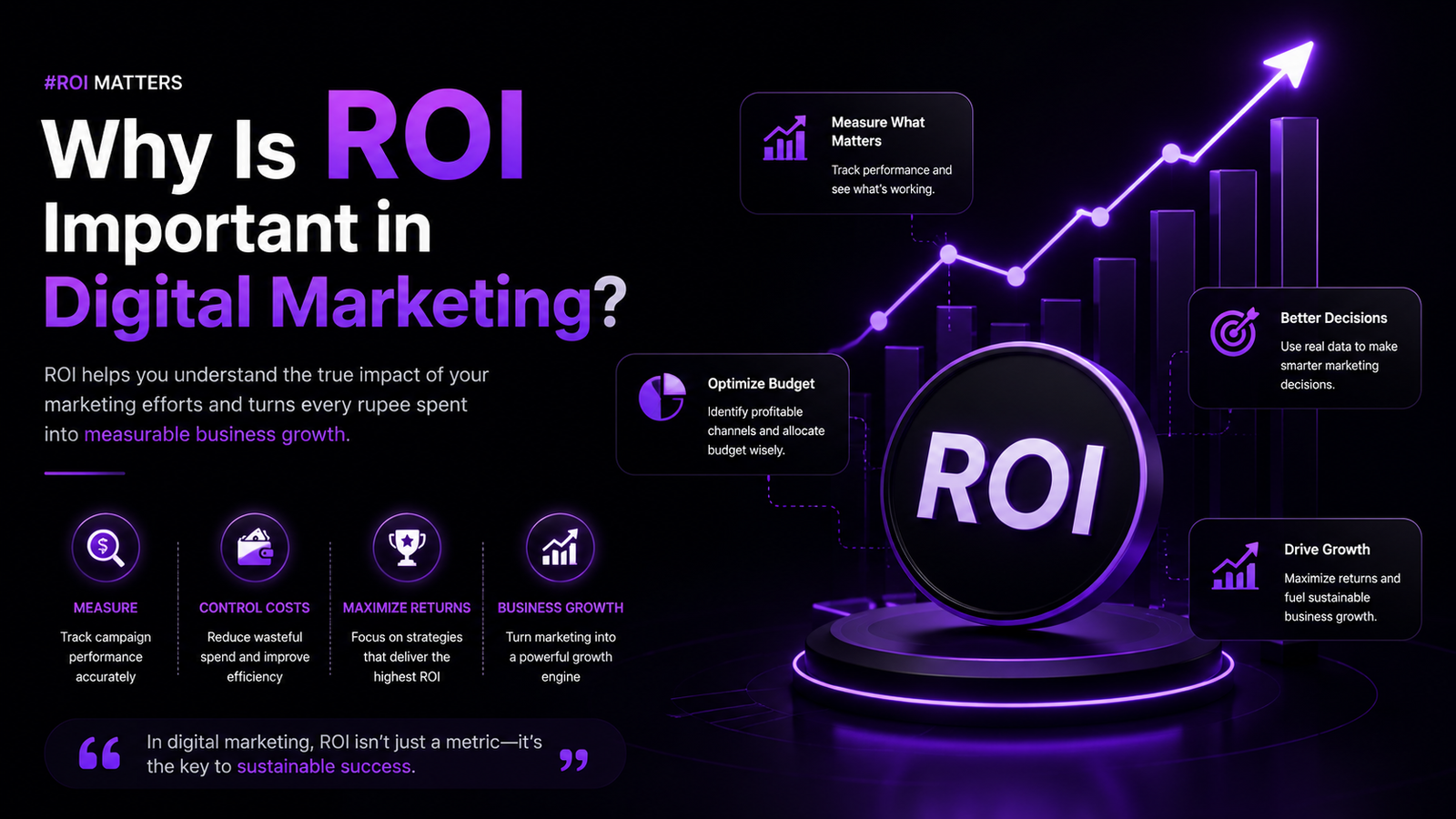
Measuring ROI is important because businesses need to understand how effectively their marketing budgets are being used.
1. Helps Measure Marketing Performance
ROI gives businesses a way to evaluate whether their campaigns are producing valuable results.
Instead of focusing only on likes, views, or impressions, marketers can look at financial outcomes and conversions.
2. Helps Control Marketing Costs
Businesses can identify campaigns that are consuming large amounts of money without generating sufficient results.
This allows marketers to reduce unnecessary spending and allocate budgets more effectively.
3. Helps Identify Successful Campaigns
ROI measurement makes it easier to determine which marketing channels are performing well.
For example, a business may discover that its email marketing campaign generates a higher return than its social media advertising campaign.
4. Supports Better Decision-Making
Marketing decisions should be based on data rather than assumptions.
By analyzing ROI, marketers can make informed decisions about where to increase, decrease, or maintain their marketing investment.
5. Improves Future Campaigns
ROI analysis can reveal what worked and what did not.
These insights can be used to improve future campaigns, targeting, messaging, content, and advertising strategies.
How to Calculate ROI in Digital Marketing
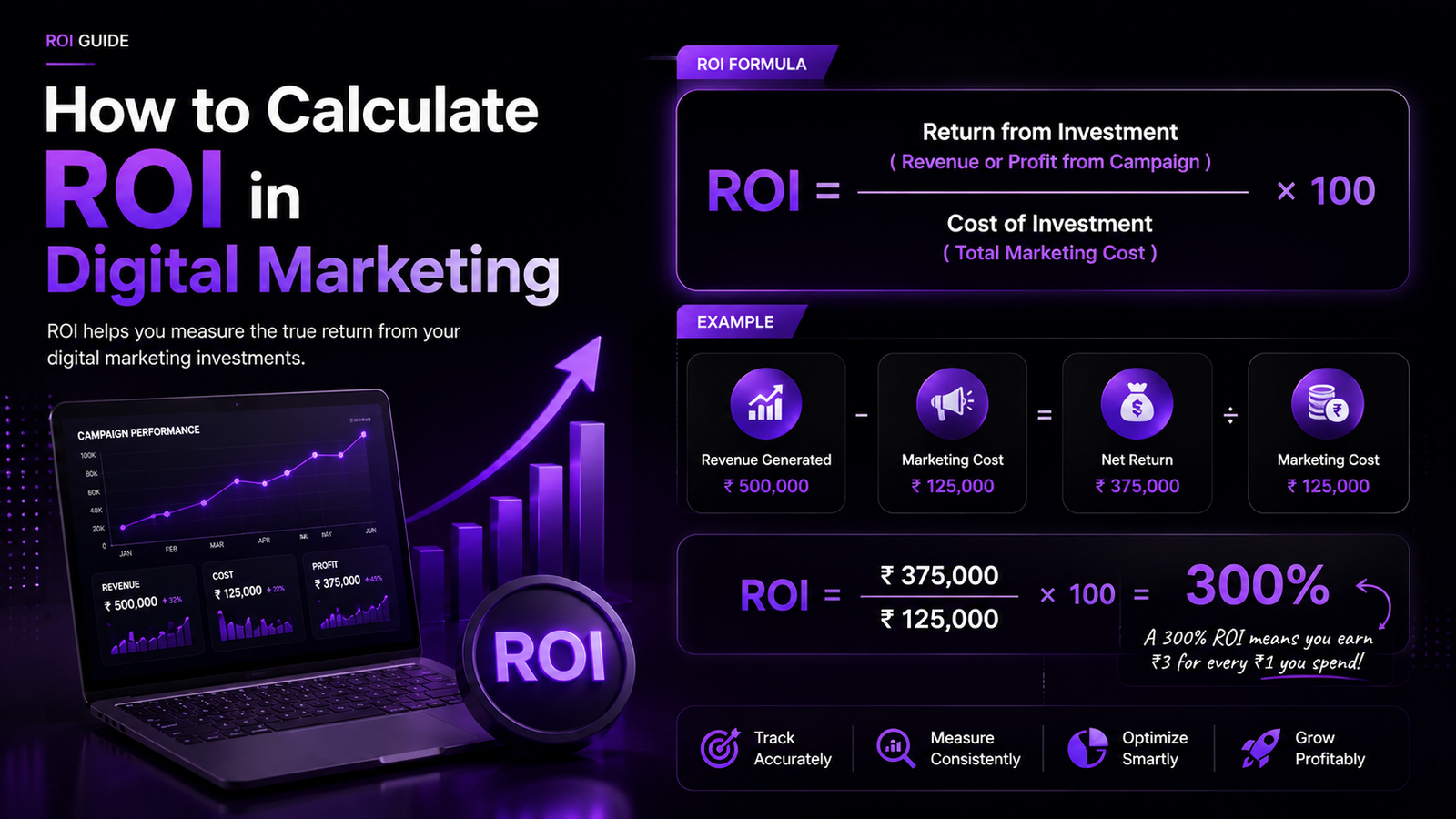
The basic ROI formula is:
ROI = (Return from Investment − Cost of Investment) ÷ Cost of Investment × 100
For example, imagine a company spends ₹20,000 on a digital marketing campaign and generates ₹50,000 in revenue.
ROI would be:
(₹50,000 − ₹20,000) ÷ ₹20,000 × 100 = 150%
This means the campaign generated a 150% return based on the calculation above.
However, marketers should be careful when using revenue instead of profit. Revenue is the total amount generated from sales, while profit accounts for relevant costs.
For more accurate digital marketing ROI measurement, businesses should determine which costs and returns are attributable to the campaign.
Important Metrics for Measuring Digital Marketing ROI
ROI is not the only metric marketers should monitor. Several other metrics help explain why a campaign is performing well or poorly.
1. Conversion Rate
Conversion rate measures the percentage of users who complete a desired action.
A conversion could be:
- Making a purchase
- Filling out a form
- Signing up for a newsletter
- Downloading an ebook
- Booking a service
- Requesting a quotation
A higher conversion rate can indicate that a campaign is successfully turning visitors into customers or leads.
2. Customer Acquisition Cost
Customer Acquisition Cost (CAC) measures how much it costs a business to acquire a new customer.
A basic formula is:
CAC = Total Marketing and Sales Costs ÷ Number of New Customers
For example, if a company spends ₹50,000 and acquires 100 customers:
CAC = ₹50,000 ÷ 100 = ₹500 per customer
Businesses can compare CAC with customer value to understand whether their acquisition strategy is sustainable.
3. Cost Per Lead
Cost Per Lead (CPL) is particularly important for businesses that generate leads instead of direct online sales.
The formula is:
CPL = Total Campaign Cost ÷ Number of Leads Generated
If a campaign costs ₹10,000 and generates 200 leads:
CPL = ₹10,000 ÷ 200 = ₹50 per lead
A low CPL can be useful, but marketers should also consider lead quality. A campaign that generates inexpensive but unqualified leads may not produce a strong ROI.
4. Return on Ad Spend
ROAS, or Return on Ad Spend, measures revenue generated from advertising compared with advertising costs.
The formula is:
ROAS = Revenue from Ads ÷ Advertising Cost
For example, if a business spends ₹20,000 on advertising and generates ₹80,000 in attributed revenue:
ROAS = ₹80,000 ÷ ₹20,000 = 4
This means the campaign generated ₹4 in revenue for every ₹1 spent on advertising.
ROAS is especially useful for evaluating paid advertising campaigns.
5. Customer Lifetime Value
Customer Lifetime Value (CLV) estimates how much revenue or profit a customer may generate over their relationship with a business.
This is important because a customer may make multiple purchases over time.
A campaign that appears expensive based on the first purchase may actually be profitable if customers continue buying from the business.
ROI of Different Digital Marketing Channels
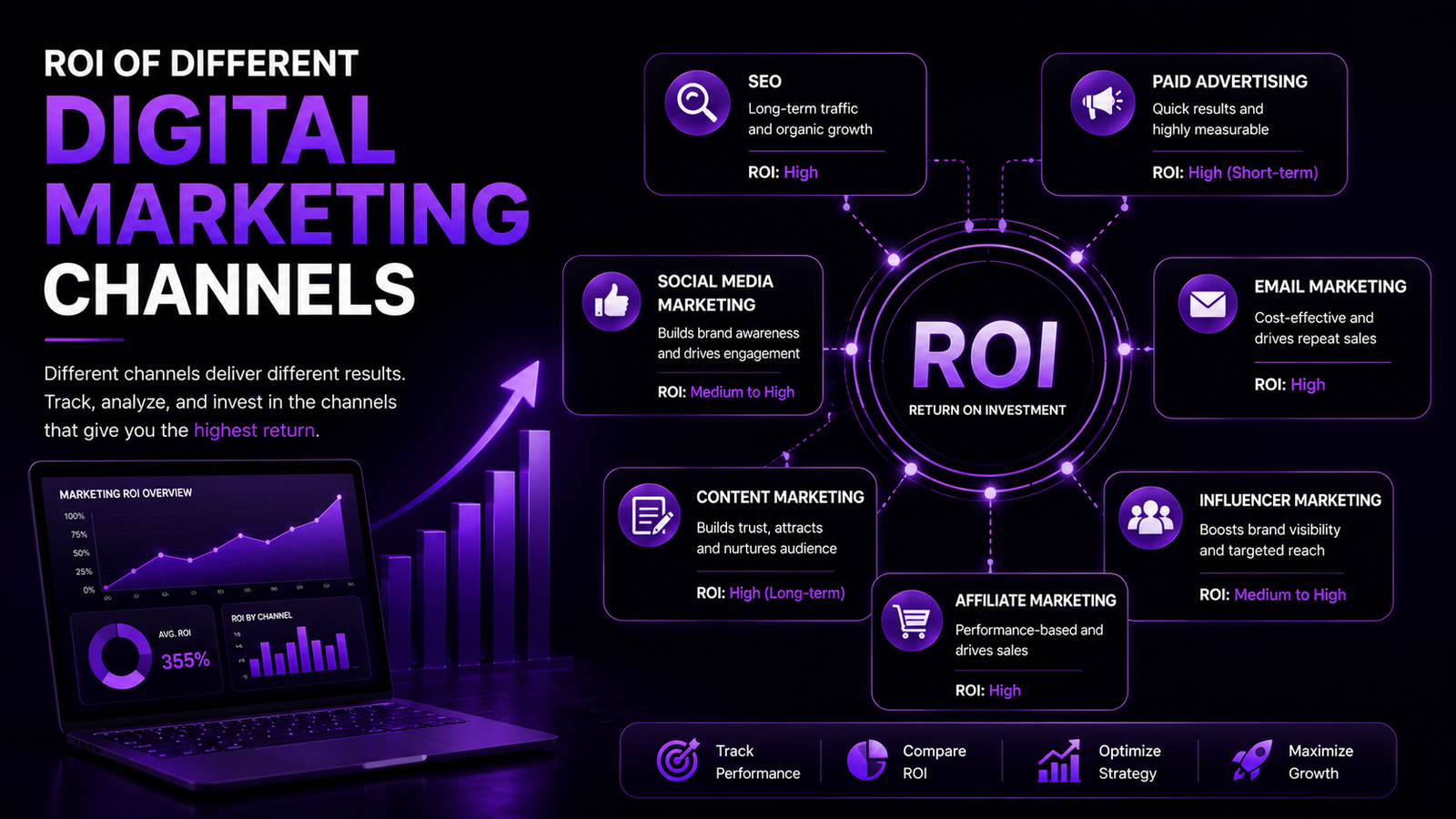
Different digital marketing channels can produce different types of returns.
Social Media Marketing ROI
Social media marketing can generate both direct and indirect returns.
Businesses can measure:
- Engagement
- Reach
- Website traffic
- Leads
- Sales
- Follower growth
- Conversions
- Brand mentions
Not every social media result can be immediately converted into a monetary value. For example, increased brand awareness may influence future purchases.
Paid Advertising ROI
Paid advertising platforms can provide detailed performance data.
Marketers can track:
- Impressions
- Clicks
- Click-through rate
- Cost per click
- Conversions
- Cost per acquisition
- Revenue
- ROAS
This makes paid advertising one of the easier channels for measuring direct campaign performance.
Email Marketing ROI
Email marketing can be highly measurable because businesses can track opens, clicks, conversions, and purchases.
Businesses can improve email marketing ROI by:
- Segmenting audiences
- Personalizing messages
- Creating useful content
- Testing subject lines
- Using strong calls to action
- Removing inactive subscribers
Content Marketing ROI
Content marketing includes blogs, videos, guides, ebooks, podcasts, and other educational content.
Content may not generate immediate sales. A customer might read several articles before eventually making a purchase.
Therefore, marketers should consider both short-term and long-term results when evaluating content marketing ROI.
How to Improve ROI in Digital Marketing
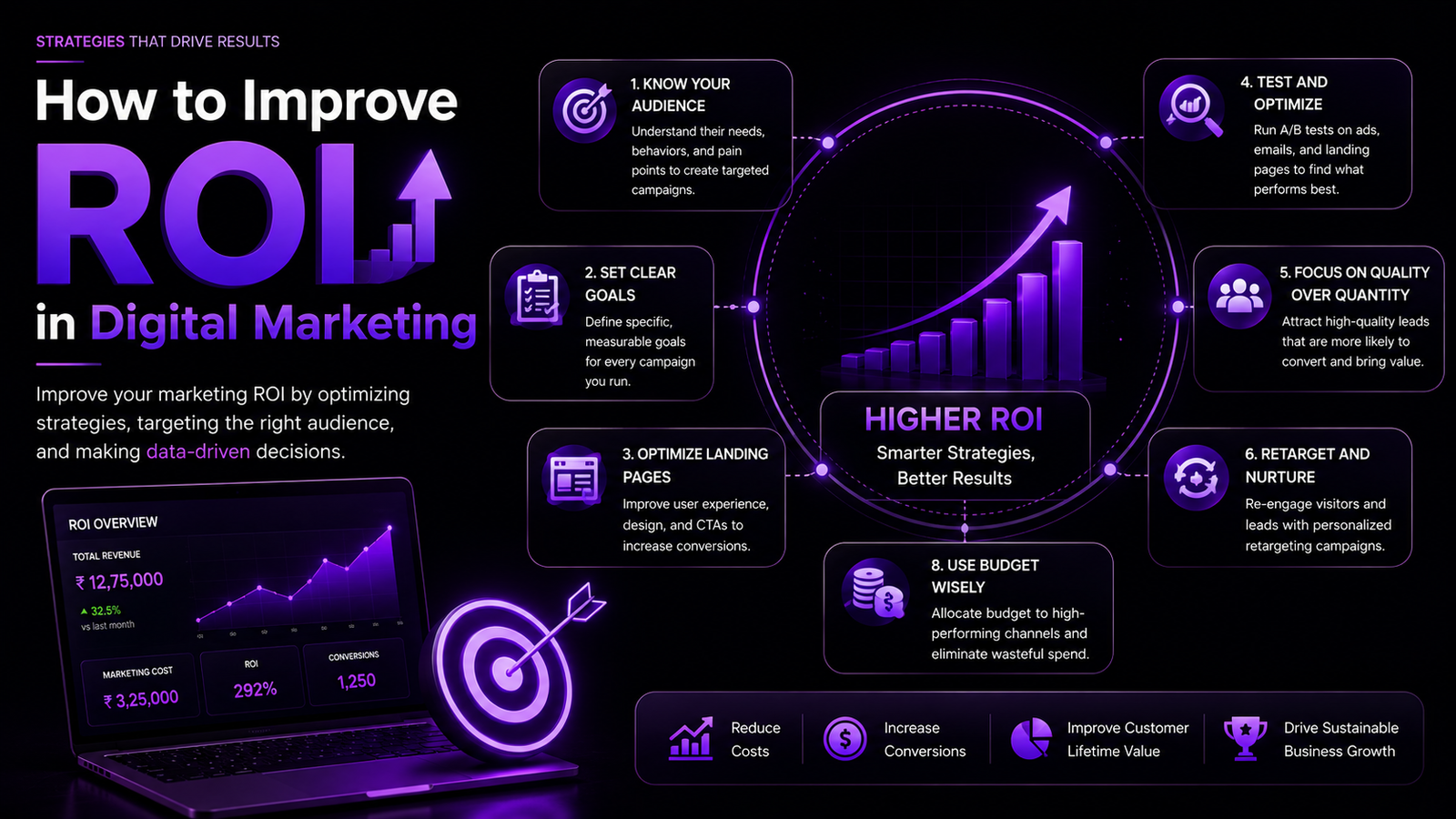
Improving ROI does not always mean spending more money. It often means using the existing budget more effectively.
1. Understand Your Target Audience
A clear understanding of your target audience helps you create relevant campaigns.
Research their:
- Needs
- Problems
- Interests
- Online behavior
- Purchasing habits
- Preferred platforms
Better targeting can improve conversion rates and reduce wasted spending.
2. Set Clear Marketing Goals
Every campaign should have a specific objective.
For example:
- Generate 500 leads
- Increase online sales by 20%
- Reduce customer acquisition cost
- Increase website conversions
- Improve ROAS
Clear goals make performance easier to measure.
3. Optimize Landing Pages
A digital advertising campaign may receive many clicks but generate few conversions because of a poor landing page.
Improve landing pages by using:
- Clear headlines
- Relevant content
- Strong CTAs
- Simple forms
- Mobile-friendly design
- Trust signals
- Fast loading speeds
4. Test Different Campaigns
A/B testing can help marketers identify which version performs better.
Businesses can test:
- Headlines
- Images
- Videos
- CTAs
- Ad copy
- Landing pages
- Offers
Small improvements in conversion rates can have a significant impact on overall ROI.
5. Focus on High-Quality Leads
Generating thousands of leads does not necessarily mean a campaign is successful.
Businesses should focus on attracting people who are genuinely interested in their products or services.
High-quality leads are more likely to become paying customers.
6. Retarget Existing Visitors
Some users may visit a website without making a purchase.
Retargeting campaigns can remind these users about the business and encourage them to return.
Because these users have already shown interest, retargeting can sometimes be more efficient than targeting completely new audiences.
Common Challenges in Measuring Digital Marketing ROI
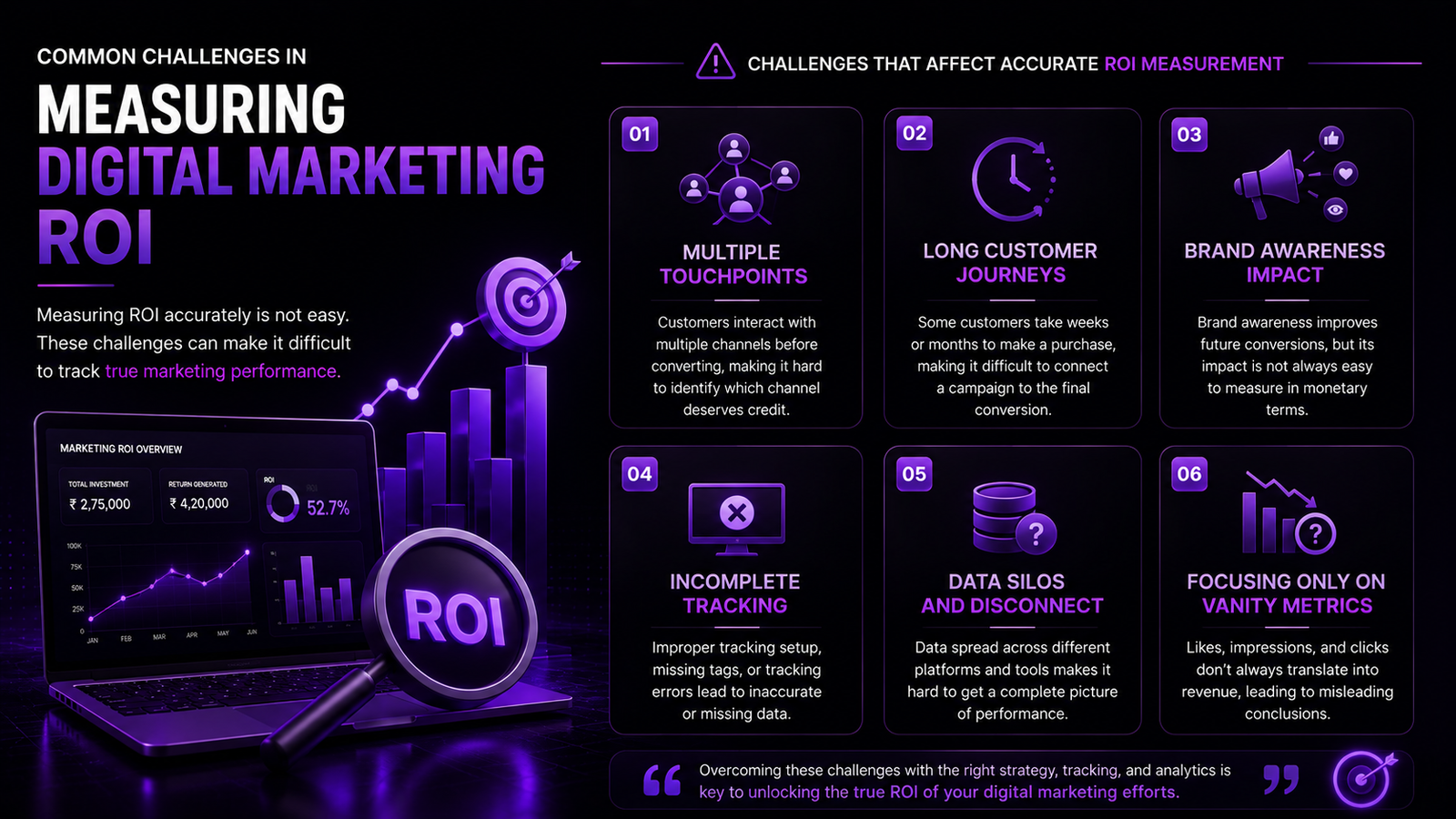
Although ROI is extremely useful, measuring it accurately can be challenging.
Multiple Marketing Touchpoints
A customer may see an Instagram post, click a Google search result, read a blog, and later purchase through an email campaign.
Which channel should receive credit?
This is known as an attribution challenge.
Long Customer Journeys
Some customers take weeks or months before making a purchase.
This makes it difficult to connect a particular marketing activity directly to the final sale.
Brand Awareness
Brand awareness can influence future purchases but may not immediately generate revenue.
Therefore, businesses should not evaluate every campaign only by immediate sales.
Incomplete Tracking
Poor analytics setup can result in missing or inaccurate data.
Proper tracking systems are essential for reliable ROI analysis.
The Role of Analytics in ROI Measurement
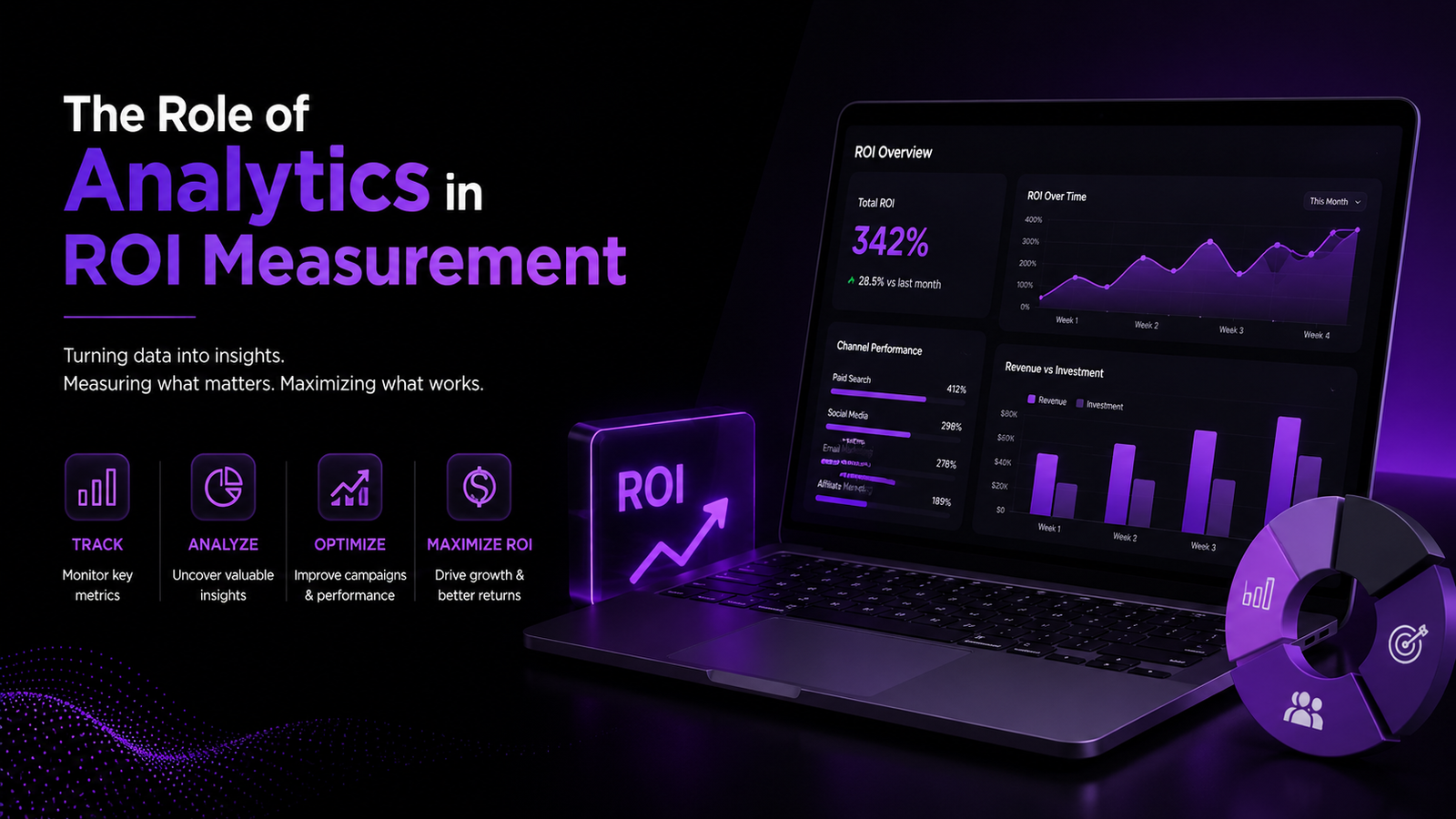
Analytics tools help marketers understand how users interact with digital campaigns.
Businesses can analyze:
- Traffic sources
- User behavior
- Conversions
- Campaign performance
- Audience characteristics
- Revenue
- Customer journeys
By combining analytics data with sales information, businesses can gain a better understanding of their digital marketing ROI.
The goal is not simply to collect data. The goal is to turn data into useful marketing decisions.
ROI vs ROAS: What Is the Difference?
ROI and ROAS are related but different metrics.
ROI evaluates the overall return from an investment after considering relevant costs.
ROAS focuses specifically on revenue generated from advertising expenditure.
For example, a company may have a strong ROAS from an advertising campaign but a lower overall ROI after accounting for product costs, salaries, software, shipping, and other expenses.
Therefore, marketers should choose the metric that matches the question they are trying to answer.
Future of ROI in Digital Marketing
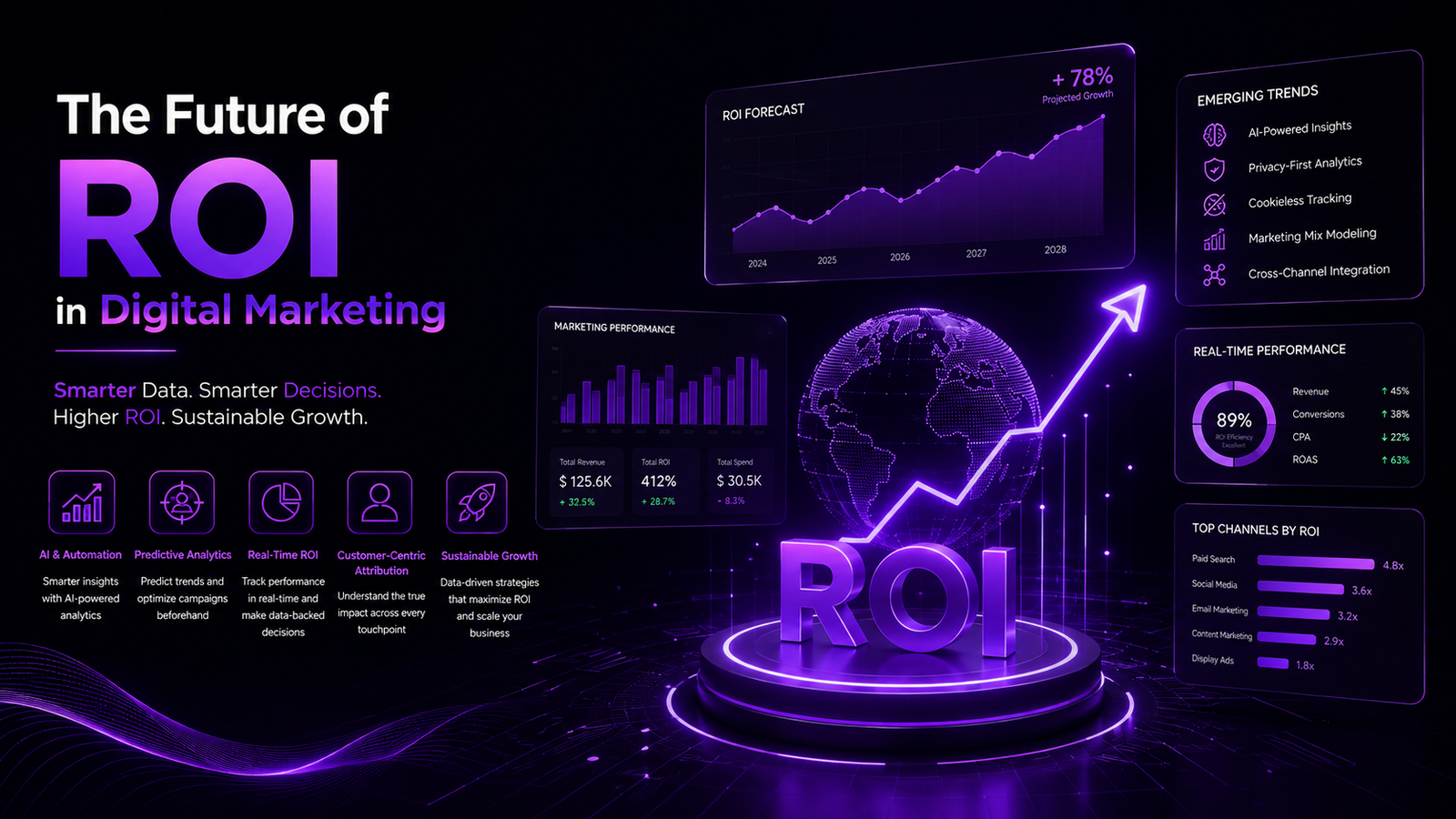
The future of ROI in digital marketing will become increasingly data-driven.
Artificial intelligence, automation, advanced analytics, and improved attribution systems are helping businesses understand customer behavior more effectively.
Marketers will increasingly focus on connecting marketing activities with actual business outcomes.
Instead of simply asking:
“How many people saw our campaign?”
businesses will ask:
“How did this campaign contribute to our business growth?”
This shift will make ROI measurement even more important.
Conclusion
ROI in digital marketing is one of the most important concepts for businesses that want to make smarter marketing decisions. It helps marketers understand whether their investments are producing valuable results and which strategies deserve more attention.
From SEO and social media marketing to paid advertising, email marketing, and content marketing, every digital marketing channel can be evaluated using relevant performance metrics.
However, measuring ROI is not simply about looking at revenue. Businesses should consider conversion rates, customer acquisition costs, lead quality, ROAS, customer lifetime value, and long-term business impact.
The most successful marketers use ROI measurement as an ongoing process. They set clear goals, track meaningful data, test different strategies, analyze results, and continuously optimize their campaigns.
Ultimately, the goal of digital marketing ROI is not just to spend less money. It is to generate more value from every marketing investment and build sustainable business growth.
auther:shamil